
One of the most important roles CalWEP plays for its members is ensuring that the experience of water suppliers is in the room where water policy is discussed.
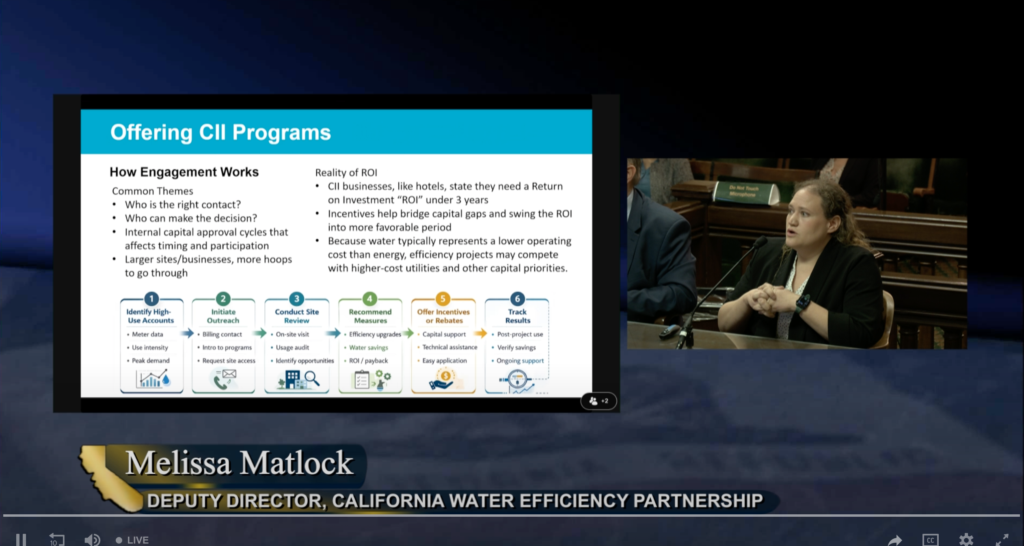
On March 11, that role brought CalWEP to the California State Capitol, where we participated as an expert witness before the California State CalWEP’s Deputy Director Melissa Matlock served this week as an expert witness before the California State Assembly Water, Parks, and Wildlife Committee in Sacramento during a hearing focused on the efficiency of large Commercial, Industrial, and Institutional (CII) water users.
The hearing provided an opportunity to share how water suppliers across California plan for and manage large water users, and to explain some of the real-world challenges agencies face when working to improve water efficiency in this sector.
A key point discussed during the hearing is that water suppliers are already planning for commercial and institutional water demand long before new development is built. California has an established framework that helps ensure water supplies are sufficient for growth. Urban Water Management Plans evaluate long-term supply reliability over a 20-year planning horizon, while Water Supply Assessments and Water Supply Verifications examine whether sufficient water is available to support large new developments. Through these processes, water suppliers work closely with local governments and developers to understand projected demand and ensure that new development aligns with available water resources.
However, planning for water demand is only the first step.
Once large facilities are built and connected to the water system, water suppliers face a very different challenge: understanding how water is actually being used within those sites. Agencies typically see water use through a single meter serving an entire property. From that meter, utilities can track consumption patterns, meter size, billing classifications, and sometimes peak demand through advanced metering infrastructure. What they cannot always see is how water is distributed inside the facility.
A single commercial or institutional property may use water for irrigation, cooling towers, food service, manufacturing processes, sanitation, or other operational needs. Without direct visibility into those uses, identifying opportunities for water efficiency requires a combination of data analysis, outreach, and collaboration with facility managers.
In many cases, improvements also depend on business investment decisions. Companies often evaluate efficiency upgrades based on return-on-investment thresholds, frequently looking for relatively short payback periods before approving capital improvements. Because water costs are often lower than other utilities such as electricity or natural gas, water efficiency projects can compete with other operational priorities inside a facility.
This is where programs, incentives, and technical support become critical tools for helping businesses identify and implement water-saving opportunities.
Supporting water suppliers in this work is a central part of CalWEP’s mission. Through collaboration with our members, CalWEP is developing resources designed to help agencies better understand their commercial and institutional customers and engage them more effectively. Completed initiatives include development of a CII classification guidebook, tools to help agencies identify and map disclosable buildings under state requirements, and new guidance on outreach strategies for engaging large water users.
Additional resources in development include a workbook to help agencies identify high water users and prioritize efficiency outreach, as well as a Best Management Practices database that will provide information on program design and estimated water savings. Together, these tools are intended to help water suppliers move from understanding demand to implementing effective efficiency strategies that support long-term conservation goals.
Participating in the legislative hearing provided an opportunity to share these perspectives directly with policymakers. It also reinforced the importance of ensuring that statewide policy discussions reflect the operational realities faced by local water agencies on the ground.
By bringing those perspectives into legislative discussions, CalWEP helps ensure that water suppliers have a voice as California continues working toward a more resilient and efficient water future.

Melissa Matlock
Deputy Director
California Water Efficiency Partnership